« October 2009 | Main | December 2009 »
November 30, 2009
Dubai the dream of modernity
Dubai World, the Dubai government's investment arm, asked investors for some extra time to make its debt payments. Dubai World is shouldering almost $60bn (£36.5bn) in debt, and is now seeking a six-month moratorium on repayments sent shockwaves through world markets.
The carefully crafted image of brash, glitzy modernity -- the dream of Dubai as modernity's Arab city of global significance, like pre-modern Córdoba and Baghdad. It is marked as model of a global city in a backward Arab region which has miserably failed to overcome its conflicts or meet the aspirations of its young population.

This dream has dissolved. There is now an alarming disconnect between the bubble of the Dubai city-state, the most populous city in the United Arab Emerite and the real world.
Is it just another commercial real estate bust? No big deal really. Property prices in the emirate had fallen 50% from their peak and follies including a set of man-made islands in the shape of the world map in an era of rising sea levels, have been left half-built. Similar to, or not not that different from many Australian property groups that have assembled huge asset portfolios based on borrowed funds?
Or does it sound like sovereign debt: is the emirate bust, as surely as modern-day Iceland, or Argentina in the 1990s, or Germany in the 1920s? Does the Dubai situation signifies that although the major central banks around the world have stabilized the financial system, they can’t make all the excesses simply disappear. For though the recovery is proceeding significant pitfalls lie ahead.The financial system is still unstable.
Abu Dhabi is putting the pressure on Dubai to become more conservative as it helps bail Dubai out of its debt. Why would anyone to vacation in Dubai?
Posted by Gary Sauer-Thompson at 6:28 AM | Comments (1) | TrackBack
November 29, 2009
Hockey's moment in the sun?
Some in the Canberra Press Gallery say that Turnbull's woes and trouble have been mostly been his own doing. His leadership style is too imperious, his crash-through style is not consultative, he doesn't listen etc etc. Either the crash or crash through wrecks the party. So Turnbull has to go, if the disarray is to be overcome.
My judgement is that though Turnbull's crash-through style has contributed to his predicament, this predicament is caused by the irreconcilable divisions within the Liberal Party. So I am more sympathetic to Tony Wright's interpretation, as it is built around the split or schism within the Liberal Party.
He argues that Senator' Minchin's short term strategy is to ensure the Senate debate on the endless emissions trading scheme amendments — about 200 of them — is strung out in until he and his lieutenants had put in place the means to lever Malcolm Turnbull out of his job.
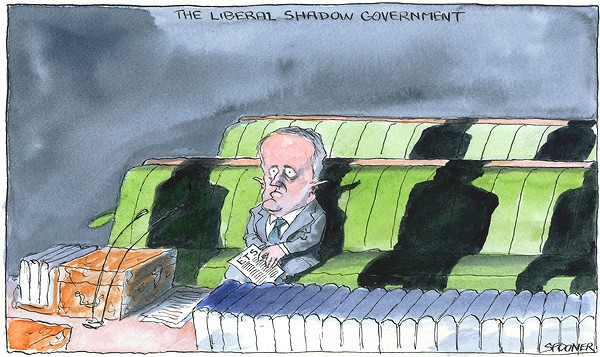
The mechanism was the conservatives mass resignation from the shadow cabinet and thenplacing pressure on Hockey to stand for leadership as a unity candidate against Turnbull and then to become the mouthpiece of Minchin's conservatives. That involves switching the party room’s support for the emissions deal and sending it to the freezer.
So Hockey, a climate change progressive, would owe his leadership, and be beholden, to Minchin's climate change sceptics and denialists. Hockey's moment as consensus builder has come: to unite the party and attempt to minimise a further loss of seats in the 2010 election.
What "consensus builder" covers up is that the the party of Menzies has turned destructively on itself in an implosion of rage and resentment on the issue of climate change. Behind using Hockey to lightly paper over the cracks (the "cuddly face" of the Liberal Party spouting Minchin's hardline views on climate change) lies the strategy of the Minchin conservatives (the religious right, the climate sceptics, the big-C social conservatives).
This strategy is about policy differentiation with the Rudd Government, standing on their core principles and staying true to their base. Come 2010 and we will have a pared-down Liberal Party that will emerge from the ashes that Turnbull leaves behind.
Update
The consensus commentary of the Canberra Press Gallery says that the ground has shifted in the Liberal Party against Turnbull and an ETS. Surprisingly, the Nielsen Poll indicates that Turnbull is getting increasing approval from the people the Liberal Party needs to win the votes of in order to perform well at an election (ALP voters), yet he is bleeding approval from the Coalition base. Turnbull has become isolated from his own party.
The Hockey and Dutton team will replace Turnbull, the ETS will be sent off to a Senate committee, the Liberal Party has turned against climate change and becomes the party of climate change deniers and coal interests, and Hockey appears to dump his own beliefs on the emissions trading scheme. Hockey now becomes the cuddly mouthpiece for Minchin and Abbott's economic liberalism + social conservatism.
Since there will be no support for the emissions trading scheme from the Liberal Party Hockey's suffering has just begun. An election loss looms in 2010 for the Liberals, as they turn away from the middle ground and retreat to the safety and security of their base leaving the ALP standing firm in the middle ground.
Update
The Minchin strategy of Liberal senators stretching out debate on the emissions legislation in the Senate while they wait for a new leader to withdraw Turnbull's order to support the bills has come unstuck. Two Liberals (Humphries + Troeth) would not support it, nor would Fielding. Hockey, instead of opposing the legislation is in favour a free conscience vote in the Senate. There are enough Liberal Senate votes (10-12, including Gary Humphries, Marise Payne of NSW, Queenslanders Sue Boyce and George Brandis, South Australian Simon Birmingham and Victorians Michael Ronaldson and Judith Troeth ) to ensure the passage of the legislation.
Minchin's conservative refused to accept Hockey's position for deferral of a vote on the Carbon Pollution Reduction Scheme to February plus of a free conscience vote on the legislation. Abbott is standing for the denialists anti-ETS camp in a three way contest. The consensus is that Turnbull has lost majority support in the partyroom and will be removed if the leadership spill succeeds. His body language shows he knows this and he comes across as bravado without hope. Hockey is still expected to win.
What does Turnbull do?
Posted by Gary Sauer-Thompson at 8:43 AM | Comments (15) | TrackBack
November 28, 2009
As in Australia so in the US
As in Australia so in the US with respect to acting on climate change. As Jeffrey Sachs observes:
There are several reasons for US inaction – including ideology and scientific ignorance – but a lot comes down to one word: coal. No fewer than 25 states produce coal, which not only generates income, jobs and tax revenue, but also provides a disproportionately large share of their energy... Since addressing climate change is first and foremost directed at reduced emissions from coal – the most carbon-intensive of all fuels – America's coal states are especially fearful about the economic implications of any controls
For Australia just think Queensland, NSW , Victoria, South Australia--coal states. Minimal reform with lots of public subsidies is their game plane. Now think coal state senators with their blackhats.
Sachs says that:
until recently, many believed that China and India would be the real holdouts in the global climate change negotiations. Yet China has announced a set of major initiatives – in solar, wind, nuclear, and carbon-capture technologies – to reduce its economy's greenhouse gas intensity. India, long feared to be a spoiler, has said that it is ready to adopt a significant national action plan to move towards a trajectory of sustainable energy.
Sachs asks: "could the US Senate really prove to be the world's last great holdout?" Nope. There is the Australian Senate since many Coalition Senators senators from the coal states are unlikely to support decisive action on climate change, other than to prevent the economic impact on the coal states and to demand even more favours for business.
They are not concerned about market failure, or how to produce much more energy with much less CO2, nor with influence the demand side of the market, leading to consumers adopting more sustainable behavior by making sustainable low-carbon choices. Nor do they talk about making buildings more efficient or mandating green buildings.
I can imagine some blackhat Senators saying that if energy efficiency worked, everyone would have done it already. When others look a bit puzzled they would elaborate along the lines that what they meant was that this is like the joke about the two economists who ignore a $100 bill they see lying on the street, figuring that if the money were real someone would have picked it up.
So what is Copenhagen about? The conservatives would say that these good guys are a good guide to what is going on. One of them--Lord Monckton spoke at a recent IPA conference in Australia. There is nothing online from the conference, but some of Monckton's climate change denial rhetoric can be foundhere.
Posted by Gary Sauer-Thompson at 11:51 AM | Comments (3) | TrackBack
November 27, 2009
Twitter + politics
Twitter is definitely the space to be in if you want to follow the flow of the unfolding events in the fracturing Liberal Party's meltdown this week. The journalists were reporting from Parliament and now from interviews in Melbourne, Sydney and Canberra --the Senate is still debating the ETS. This technology allows political junkies to follow, and comment on, both what is being said by whom about the unfolding events, and the political assemblages being put together to link the different factions across the ETS schism.
The media, like us bloggers, then update a few hours latter online by pulling some of the different flows together with commentary. Twitter has changed journalism. As Julie Posetti points out at her J-Scribe:
There is currently real journalistic value in Twitter. And that value is not best extracted by dropping into others’ sites as a non-user, but in creating a journalistic identity for yourself on the platform; by making new connections outside your professional and personal silos; by genuinely engaging with followers – not just using the medium as another broadcast device....Twitter is entrenching the new news order: where the top-down model of information delivery presided over by an elite few is being swapped for peer-to-peer delivery on online social networking sites …the story-tellers are among us and they’re setting their own news agenda
Who to follow on Twitter? Peter Black makes some suggestions. In his article at Unleashed Alex Bruns acknowledges the significance of Twitter for journalists:
The instant updates, the direct access to sources, the ad hoc exchanges which Twitter and similar services enable can be a powerful addition to the journalistic toolkit, and a significant means for informing and mobilising the masses - for alerting them of a need to flee devastating bushfires or for organising them in street protests against the stolen Iranian elections, to name just two recent examples.
This points to the potential for the deepening the links between journalism and liberal democracy. However, Bruns argues that the journalist's practice in Australia during the meltdown of Liberal Party was different to the bushfires and the Iranian street protests.
His reservations are with the technology itself on the context of the journalism practised by the Canberra Press Gallery. He says:
By enabling an instantaneous, downright hyperactive mode of communication as it does, there's a danger that Twitter will further emphasise process over substance. In the right hands, it is an important tool for tracking the Zeitgeist, checking information, and accessing a wide range of sources quickly and easily; in the hands of a journalist who is already struggling with time pressures and the need to produce copy, however, there is a real fear that the independent, fearless analysis and interpretation of events which should be at the heart of journalistic work will fall further by the wayside.
This is probably right. But, as Bruns implies there are journalists and journalists within the Canberra Press Gallery. Some report on events (news) and some write op-eds (commentary) whilst some can tweet regularly and do an analysis of events by providing an overview of the state of play or interpret the politics behind the surface events.
Bruns unpacks what he means by process over substance:
...much of the journalism Australians were able to witness this week was just that - a breathless coverage of process, a counting and recounting of who said what and which side appeared to have the votes, rather than a serious engagement with the substance of the CPRS bill, the amendments being added, and the wider context of Australia's response to the threat of climate change. Lateline and all the other shows reporting on the political events of the day did little more than repeat - retweet - the pithy comments which journalists and others had already made to each other as they day unfolded.
True, once again. But then the ETS was a political response to global warming by theALP, and one designed to place maximium pressure on Malcolm Turnbull's leadership deepen the fractures within a divided Liberal party and ensure a big Rudd victory in 2010. It was not designed to reduced greenhouse emissions as it was captive to the fossil fuel industry from its early days.
The constant pressure from the Rudd Government in the form of taunts, ridicule and mocking denigration worked ---the Liberal Party imploded over the McFarlane ETS deal and Turnbull's determination to modernize the Liberal Party by bringing it into the 21st century. The politics of the implosion caused by the revolt of the conservatives is the story.
Now Bruns digs deeper as he links the chattering surface journalism to a flaw with the Canberra Press Gallery itself. He says:
Such failings are excusable in the face of the extraordinary political theatre which is playing out at the moment, perhaps, but unfortunately they are not confined to a handful of such special days - even at the best of times, much of the Canberra commentariat generally appears to be more interested in reporting the latest leadership machinations within opposition ranks than in providing an insightful critique of government policy. And there's also a danger that the tweetback loop between politicians, pundits, and journalists becomes even more self-contained, even more disconnected from everyday life.
True, once again with respect to the way that the journalism of the Canberra Press gallery is more leadership politics rather than insightful critique of government policy. However, the Liberal Party implosion does conjoin policy and leadership in that the Minchin conservatives are opposed to climate change, an ETS and Malcolm Turnbull.
The vacuum around 'insightful critique' in the public sphere has given rise to political blogging and the emergence of online journalism that goes behind the headlines. Journalism has stepped beyond the old confines of the Canberra Press Gallery and the feedback loop has been ruptured by different outside voices joining the conversation.
And it is a conversation that is happening, not just broadcasts from those on high.
Posted by Gary Sauer-Thompson at 12:11 PM | Comments (13) | TrackBack
November 26, 2009
Liberals implode
I've just found out from Twitter that the Liberal shadow ministry has imploded with mass resignations late this afternoon.Those who have resigned are Abbott, Minchin, Abetz, Parry, Mirabella, Smith, Johnson, Fifield, Mason, and Cormann. They have quit the frontbench over emissions trading scheme with Abbott refusing to rule out a future leadership tilt. So the Minchin conservative campaign continues.
So the Conservatives, who lost the policy debate in the party room, are repudiating the party room agreement and attempting to takeover the Liberal Party and shift the Liberal Party further to the right. Is Malcolm Turnbull toast? Will he agree with the Government to guillotine debate on the CPRS in the Senate and to push the vote through tonight? Or will there be no guillotine of the debate. Does 'hope and change' Turnbull stand and fight the recalcitrant conservatives in his own party?
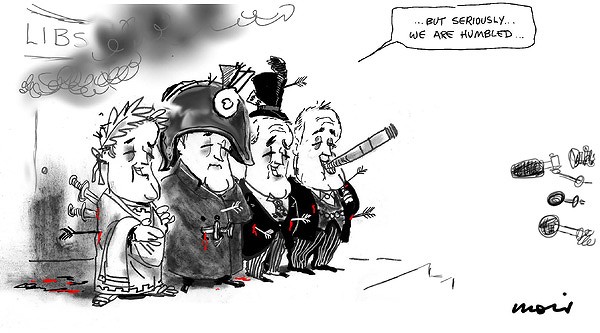
Another, more remote, possibility is that Turnbull quits, Abbott is installed, the GPRS deal is cancelled, and Rudd calls a double dissolution; or, in another variation, Rudd fights a late 2010 election on global warming, the Greens gain control of the Senate and Rudd cuts deal with Greens. I can hope. Pity about Turnbull's sacrifice for the nation.
The reality is that an Abbott-lead conservative Liberal Party with Minchin in control, and deeply opposed to emissions trading scheme, is a party of global warming denialists and social conservatives. It would lose seats in a 2010 election as the Liberal Party appears as squabbling rabble torn apart by a deep ideological schism. The schism is reminiscent of the ALP in the 1950-60s.
Turnbull stays and fights the recalcitrant, angry conservatives. Resignation is not an option. He is a conviction politician. Is this his last press conference bar one?
What now? (People Skills) Abbott will probably challenge Turnbull early next week. At this stage Minchin and Abetz bizarrely agreed to stay on to shepherd the ETS legislation through the Senate that they'll vote against tomorrow afternoon. So the smoke and mirrors GPRS legislation passes. Pity.
Update
What of the Liberal Party's future direction? Bob Ellis has a go. Turnbull deserved better. So it's back to the Howard past? That is where the soul of the Liberal Party can be found, say the resentful conservatives. Turnbull has broken our hearts. He just has to go. We want anyone but Turnbull.
So they will destroy the Liberal Party to save the Liberal Party? Chris Uhlmann explores the options:
If the Liberal Party chooses him [ Abbott] it risks becoming a political billabong. It might shore up its conservative base but it could lose its moderate supporters and it will struggle to pick up the votes it needs to win from the swinging middle ground.Through the course of the Howard years the young and women increasingly turned away from the party and it is hard to see Tony Abbott winning them back....And, should the party knock off its progressive leader and the emissions trading bill, that very clever politician Mr Rudd will be aim to strand the Liberals in the past as he runs another campaign casting himself as the future.
No doubt the Minchin conservatives know this. Their strategy is to kill off an ETS, avoid a double dissolution, and then protect the base in 2010.
They are now in damage control to patch over the implosion of the Liberal Party they've caused with its desire to return to pre-Howard state of climate change denial. Hence the plan for some sort of unity (conservative+liberal) ticket arranged by Minchin. Hockey + Abbott? What kind of deal? One suggestion. It's a poisoned chalice for unity candidate Hockey as he will be required to bend to Minchin He'll be required to reject the ETS legislation. He'll then lose the 2010 election, the divisions will resurface, he'll be kneecapped by the conservative faction after the election.
The strategy of the Minchin conservatives is to regain control of the Liberal Party and shift it to the right. The claim that a shift to the right means small government, personal responsibility, deregulated labour markets and low taxes is undercut by the Big Government of Howard, social conservatism without the compassion and the tendency towards authoritarianism.
Posted by Gary Sauer-Thompson at 4:35 PM | Comments (25) | TrackBack
Open Australia
I've been interested in the ideas surrounding, or flowing from, Government 2.0. One of these was Mashup Australia, which was designed to provide a practical demonstration of the benefits that open access to public sector information can provide. I've been curious about how this could help improve my blogging by providing me with greater information.
One example of the potential that can be unlocked when government information is unlocked by pulling together data sets in new and innovative ways is Open Australia, which I stumbled upon yesterday. This is a volunteer run website that helps us to find out what our representatives are getting up to in parliament with the aim of bridging the growing democratic disconnect or deficit that many people feel.
It was always difficult for those outside Parliament to follow debates in Parliament on any issue as it involved scrolling through pages of Hansard record of the day (a pdf) to find the issue. It was too unstructured. The other option, of listening to Senate debates online via a live stream is particularly tedious, especially when the speakers are a bunch of climate change denialists.
Thus we have Senator 'free enterprise' Cory Bernadi's rhetoric about alarmists, leftists, the new religion of climate change, heretics and sceptics, political madness, Orwell’s Big Brother, climate science as a fraud and so on and so on. I just stop listening This kind of content sees climate change through the left-right prism of the culture wars, junk science and delusion in the sense of turning away from reality.
It can be found in the op-eds of Miranda Devine whose wingnut rave is about the heart of the propaganda machine of climate science that has driven the world to the brink of insanity; climate alarmists are dangerous megalomaniacs, foolish, but with enormous power. And so on.
So what does Senator Alan Ferguson, also from SA, who have to say by way of contribution to a public debate.
I am in a rather unique position, having started to make this speech last night prior to any knowledge of proposed amendments and, now, having seen those amendments, I can move on. Can I say first of all that seeing those amendments has not made me any happier. My opposition to these bills remains the same as it was. My position has not changed from last night now that I have actually seen the amendments.
No reason is given for this position. We are offered no argument as to why. It is just assumed that the dismissal of the McFarlane deal is reasonable without giving a reason. Exasperation is my response at the trashing of the values of democratic deliberation and debate.
Senator Concetta Fierravanti-Wells from NSW says:
what has troubled me about the current debate is the language and tone of the public utterances. On the one hand, there has been a fervent, almost evangelical, adherence to a view that the sky will fall in if the world does not act on climate change now. Advocates of this position have pilloried those who have dared oppose their view. They have dubbed them ‘climate change sceptics’ in tones reminiscent of the Inquisition and burning people at the stake. Some have stridently and appallingly equated them to Holocaust deniers. Yesterday’s front page article in the Australian, entitled ‘Hackers expose climate brawl’, and the release of emails only strengthen the views of those who have questioned the science. The apparent glee at the death of one such scientist by those holding opposing views is both sickening and appalling.On the other hand, people have questioned the science. We have seen scientists, such as Professor Plimer, offering alternative viewpoints.
After a while listening to this kind of rhetoric about science that makes a virtue of ignorance is just too much. I just switch off. Fierravanti-Wells is basically defending the coal interests in the Illawarra region. Ever more protection for the coal miners is her policy. This is the ground to fight an election on for the conservatives. They do not seem to realize that they would go backwards, or they don't care. It's a long term split.
Open Australia means that the information is now very easy for bloggers and citizens to access what is being said on particular debates by our local members or Senators inside Parliament. So were can see where they are coming from and how much they support a reform process. Thus Senator Birmingham from SA, in speaking on the Australian National Preventive Health Agency Bill 2009 makes the following observation says:
that no number of marketing campaigns, no number of budgets in these areas will enable you to convince or stop people from making what in the end to some extent are free choices to be able to actually decide how they lead their lives. Unhealthy lives we would all like to discourage, but there are limits to how much government should interfere in people’s lives to discourage them from leading unhealthy lives. Government is not some nanny state that is there to hold the hand of everybody each time they go to the supermarket, to tell you, ‘No, you should not put that in your shopping trolley.’ That is not the role of government and that is not what we should be seeing out of these types of preventive health agendas.
Birmingham appears to accept that a preventive approach to sickness is fundamental to any good health system but is concerned that the debate has not actually focused on when we cross the line of unnecessarily telling people how they should live their lives.
As Pip Marlow points out:
the agenda of Gov 2.0, and of the whole project of providing transparency and openness in government data, cannot be met unless we deal with the challenge of finding the “jewels”, the “gems” in the unstructured data itself.
Open Australia makes it possible to access what our representatives are actually saying behind the spin of media releases, doorstops, and media interviews. We can access what hey are saying at work, so to speak.
Posted by Gary Sauer-Thompson at 7:32 AM | Comments (1) | TrackBack
November 25, 2009
high drama in Canberra
There is a huge gap between Rudd's rhetoric on the necessity for an ETS to mitigate greenhouse gas emissions and decrease the rate of global warming ---- a "fundamental existential question for the future''----and his actions in delivering a revised GPRS. The context here is that it is now virtually impossible to limit global temperature rise to 2C and the decade long delay in acting meant the world would now do well to stabilise warming between 3C and 4C.
What we are witnessing is the politics of buying off the sqwaking opposition to an emissions trading scheme who threaten that the lights might go out. The Rudd/Turnbull ETS primarily supports the coal fired power stations, the emission intensive industry, and a host of other industries. It protects jobs and ensures that coal-fired electricity generators keep producing electricity, but it does little to reduce greenhouse gas emissions, decrease the rate of global warming, and the worsening negative impacts on nation states.

Far from Turnbull staging his own destruction he delivered. He got McFarlane's deal through the shadow cabinet and then the partyroom, even if the latter took him all day to do it. As we learned from Twitter this party room meltdown has deepened and broadened the conservative/liberal divisions in the fractured Liberal Party.
Turnbull has to now get the deal through the Senate by ensuring that Liberal Senators vote in favour of the legislation this week. He needs just 7 votes. That's reason to be confident. Turnbull has crashed through.
Despite McFarlane gaining a host of concessions from Wong and Rudd, this was not enough for the dissenting conservatives who want boss Turnbull's head now. Even though a cap and trade emissions trading scheme is a market mechanism to drive change through price, this minority remains opposed to the Liberal Party becoming relevant to the 21st century. If there is a challenge this week, the backward looking conservatives will lose.
Turnbull has not lost the war - ie, retaining his leadership through to the next election--as Peter van Onselen claims in The Australian. Nor is Turnbull a political dead man walking as Dennis Shanahan claims, since Kevin Andrews as Liberal leader borders on a farce.
The purpose of an emissions trading scheme is to drive change, raising prices to give investors the incentive to replace dirty old plants with cleaner new ones and to replace coal-fired generation with renewable energy (gas and wind energy). If Rudd and Turnbull are driving change from business as usual, while protecting business as usual, then how is Australia going to make the transition to a low carbon economy?
I cannot see the offsets in investment in renewable energy by power generating companies happening. there are too many free permits and not enough auctions. What I see in the Rudd/Turnbull business-as-usual achieving is the increased investment in coal fired power stations. WA government recommissioning two old coal-fired power stations that had been decommissioned; the Victorian Government refurbishing its existing brown coal plants; and the Queensland and NSW Governments building new coal plants.
Secondly, the coal-fired power generators + the major polluters who depend on fossil fuels will make lots of money from selling their free carbon permits whilst households pay for more for their electricity. Cap and trade is a mechanism in delay for the major polluters by buying cheap pollution permits rather than driving change by switching to renewable energy.
Thirdly, carbon trading will only achieve a modest 5% reduction in greenhouse gas emissions whilst giving the major polluters a breathing space to continuing business as usual with it's depends on an over reliance on fossil fuels.
The best that can be said is that cap and trade system is there and it may work more effectively in the future with more auctioning. However, the structural change under this system is dependent on price.Will that reduce green house gas emissions caused by an over reliance on fossil fuels. No. The price mechanism is not enough to make the shift to a low carbon economy.
Posted by Gary Sauer-Thompson at 5:40 AM | Comments (22) | TrackBack
November 24, 2009
media wars
If newspapers want to survive in the new media landscape shaped by digital technology, then the newspaper industry (and the debt-ridden commercial television one) is forced to consider new business models. The reason is the economic reality of advertising revenues slumping and circulations of printed newspapers continuing their long decline. Newspapers and televison stations have sharply cut their budgets to survive. They have closed foreign bureaus and bought out or laid off editors, reporters, and photographers.
The challenge that the Internet poses is both one of destroying the financial base of reporting and dismembering the public that the press has long had. It is probable that the national broadsheet media (eg., NYT, the Guardian, and the Australian,) will probably be able to assemble a public of sufficient size on a variety of platforms to generate the revenue to support a substantial level of reporting.
Currently, the shift to a new business model has been dominated by News Corp's very loud threats to block search engines from crawling the content of its newspapers. Google is the enemy ("parasites" that are "stealing" our content) says News Corp. Several indications of News Corp's strategy for profitmaking in a digital world can now be discerned.
First, James Murdoch told an investor conference in Barcelona that newspapers will play a smaller role in the future with a smaller online audience:
In the business of ideas, which is the business that we are in, we do think journalism plays a role, and we do think there are business models there that will make a lot of sense, albeit perhaps not at the scale of some of our broadcasting businesses and other entertainment businesses......Is it going to be as big a role? No. Structurally, television is vastly more profitable and a big opportunity.
The consequences of News Corp's shift to a paywall or subscription for its digital journalism means that it will have a smaller audience than it has by giving it away for free.
The second indication is the way that News Corp is taking advantage of Microsoft's search engine war with Google. Microsoft has approached big online publishers including News Corp to persuade them to remove their sites from Google’s search engine and index them with Bing in order to increase Bing's market share. Microsoft is willing to spend big to ensure that its Bing search engine is a success.
This is a way of enclosing News Corp's content behind a group paywall. News Corp is willing to sacrifice a lot of traffic to the websites of papers, such as the Wall Street Journal and The Times, in return for a payment from Microsoft. Since Bing’s share of the search market is under 10 per cent whilst Googles is about two-thirds of the market, this means significantly smaller online audiences and therefore a probable loss of online advertising revenues. However, Murdoch has said the Google traffic is not worth very much as the revenue from search traffic is low.
The third indication of News Corp's strategy is suggested by Paul Starr's argument in the Columbia Journalism Review that:
As the diminished public for journalism becomes more partisan, journalism itself is likely to shift further in that direction. That tendency is already apparent online, as it is in cable. And so there is a disconnect between the recommendations that Downie and Schudson offer, which reflect a tradition of nonpartisan professionalism, and the pressures of the emerging environment. Not only is the audience for news likely to become more partisan; so is the universe of potential donors to nonprofit journalism.
News Corp is in the forefront of partisan commentary style journalism--eg., Fox News and The Australian.
These three tendencies indicate a defensive newspaper strategy to protect profits in the context of the digital-media revolution and the increasing irrelevance (decomposition?) of newspapers in their printed form. They also suggest market failure in fields including Australian content, investigative journalism and rural and regional reportage.
This highlights the need for public journalism and wire or news-gathering services in the public sphere or space: a not-for-profit space by design, that exists not to make money but to serve the public and it is accountable to them.The media in this space addresses the audience as citizens, not as consumers in the marketplace.
This public journalism is one that should be supported by the universities' journalism schools producing news for the public along the lines of a "teaching hospital" model of professional education.
Posted by Gary Sauer-Thompson at 9:14 AM | Comments (11) | TrackBack
November 23, 2009
Mike Rann + all that sex
Bomshell!. Big sex scandal rocks Adelaide. Watch the video. Tabloid heaven. Who cares?
It's a political crisis in SA for a premier who campaigned on family values. Malicious and sensational says Rann. Rann is under siege apparently over sex between consenting adults.
Yawn. Another example of the new emergent puritanism?
Issues such as corruption relating to political donations, Labor nakedly getting into bed with developers who pay for the privilege and water are more important.
Posted by Gary Sauer-Thompson at 9:07 AM | Comments (14) | TrackBack
The GPRS
The big news in Canberra and politics this week will be the passing of the emissions trading scheme (CPRS) by the Senate. All the indications--as of this morning--- are that the GPRS legislation will be passed by the Senate. No doubt Minchin will probably use the filibuster tactic as his best chance of stopping the CPRS before Copenhagen, many Coalition Senators will cross the floor. There will be blood on the floor as the Liberal climate changed denialists, who don't have the numbers, threaten to blow the show up if Turnbull doesn't do what they want. High drama.
This signing into law will happen in spite of the theatrics of the deep divisions within Coalition, the forever opposed noise from the denialists, the tactics of those right wing Liberals obstructing the bill to protect the coal industry, the now naked threats from coal-fired power generators, such as Truenergy and International Power. Bring on the heat they cry in unison.

The only surprise will be how much the Rudd Government concedes to the Coalition in giving extra subsidies to the coal fired power stations in order to safe-guard the power industry-- protect even the dinosaurs from another era such as Hazelwood and Yallourn. Rudd + Co will bend over a long way in giving the power industry even more free pollution permits and to extend the compensation beyond 2015. The Brumby state government in Victoria wants that outcome as well.
No need to worry though. The CPRS is not designed to reduce greenhouse gases and it won’t do that. Hence the justified opposition from the Greens. The rorts are too great. This legislation won't achieve the levels of emissions cuts promised, nor will it drive the major technological innovations that are needed to shift our economy on to a more low-carbon path.
The only game in town is to clean up existing coal-fired power stations and make the new ones cleaner. Clean coal is the future, so let's roll out the new coal fired power stations to meet increased demand in NSW.
Posted by Gary Sauer-Thompson at 7:18 AM | Comments (19) | TrackBack
November 21, 2009
Afghanistan: a civil war
The incompetent and corrupt Afghan Karzai government would probably fall within weeks to the insurgent Taliban, if Nato pulled out troops now.
 Steve Bell
The Karzai government in Kabul is a puppet regime beholden to the warlords in the context of an Afghan civil war. So the Taliban are able to present themselves as fair administrators and the scourge of bandits and warlords after decades of war and lawlessness. They now control and govern on third the country---they pretty much control the southern provinces of Afghanistan.
What then is the rationale for being involved in a civil war?
The US does seem to building bases that indicate a long stay. Presumably, the purpose of this intervention is to prevent second coercive Taliban revolution in Afghanistan---the restoration of the Afghan state they presided over during the 1990s.
That requires counter-insurgency warfare, yet the US has no substantive and credible local partner for the centralized, "state-building" approach that remains at the heart of U.S. strategy that is being articulated by General McChrystal. So the US is engaged in a war that it won't win. Hence their limited options. The two options being considered by the Obama adminitration are:
sending in as many as 40,000 more troops to wage a full-blown counterinsurgency war (COIN in Army parlance), as General Stanley McChrystal, the top U.S. commander in Afghanistan, has recommended, or keeping the number of troops at the current level of about 68,000 to wage a more limited, counterterrorist effort aimed at al Qaeda and, to a lesser degree, the Taliban.
A third option ---ending the military occupation and leave Afghanistan to the Afghans and let them deal with al-Qaeda and the Taliban is not being considered.
Ye the point of being in Afghanistan remains unclear as this is no fight for democratic universal values and women's rights and the terrorists threat from Afghanistan is pretty low. The argument that one has to stay in Afghanistan to stop terrorist attacks at home is not persuasive, given that recent terrorist incidents in both the United States and Europe have been traced to extremists who did their training and operated out of America and the Continent.
Posted by Gary Sauer-Thompson at 5:01 PM | Comments (2) | TrackBack
November 20, 2009
When the US goes to China
President Obama didn't get much from the Chinese on his inaugural state visit as part of his first visit to Asia with respect to the law on human rights, exchange rates, sanctions on Iran, or climate change.
There is little point in the US getting the stick out as many members of the US Congress are demanding, since China is the US's creditor.The temptation in the US is to lash out at a totalitarian China for predatory trade policies looks to be very tempting for members of the US. Congress. China is anything but a faled dictatorship.

Obama's Chinese hosts were at pains to remind him that China is now the US’s creditor-in-chief and so there was a backdrop of lectures about credit bubbles in the US the urgency of raising US interest rates and narrowing its budget deficit. The debtor needed to do better as it were in getting its house in order.
That would not go down well with members of the US Congress who see the US as the superpower, are unhappy about the need for the US to more multilateral and consultative out of necessity and the economic gravity shift to Asia. The US, it appears, continues to evade the issues raised by China’s growing power rather than address them.
As Alan Kohler says in Business Spectator:
China has become such a vast creditor to the US as a result of that bubble that it now calls the shots. The US is not quite in receivership with its banker in full control, but this week’s excessively polite, uncomfortable visit had all the hallmarks of a distressed debtor's trip to the bank for a difficult meeting.
America relies on China to finance its trade deficit, whilst China needs the US to buy its goods in order to keep export-led growth on track. However China also owns over a trillion dollars in U.S. assets, the U.S. economy is on life support, and the American military is mired in two losing wars. America has a few problems it need to fix. The Obama administration is learning to manage an empire in decline.
This requires working with a China that refuses to bear the burden of the US's problems and whose economy is geared to production, not consumption. China wants to become the world's preeminent producer nation. China's export policy is really a social policy, designed to maintain order as tens of millions of poor Chinese pour into large cities from the countryside in pursuit of better-paying work.
The US does have a point about the revaluation of the RMB exchange rate. As Paul Krugman points out in the New York Times. He says that the problem of international trade imbalances is about to get substantially worse. And there’s a potentially ugly confrontation looming unless China mends its ways. Though most nations try to keep the value of their currency in line with long-term economic fundamentals China is the great exception.
Despite huge trade surpluses and the desire of many investors to buy into this fast-growing economy — forces that should have strengthened the renminbi, China’s currency — Chinese authorities have kept that currency persistently weak. They’ve done this mainly by trading renminbi for dollars, which they have accumulated in vast quantities. And in recent months China has carried out what amounts to a beggar-thy-neighbor devaluation, keeping the yuan-dollar exchange rate fixed even as the dollar has fallen sharply against other major currencies. This has given Chinese exporters a growing competitive advantage over their rivals, especially producers in other developing countries.
Krugman says that we can expect to see both China’s trade surplus and America’s trade deficit surge leading to a scenario in the US of soaring U.S. trade deficits and Chinese trade surpluses juxtapositioned with the suffering of unemployed American workers.
Posted by Gary Sauer-Thompson at 6:23 AM | Comments (10) | TrackBack
November 19, 2009
climate change politics + the media
The conservative voice of extremity is exemplified in Miranda Devine's claims in response to Rudd's Lowy Institute speech that Rudd is attempting to fashion a one-party state whilst the dissent of the climate change denialists is being stifled. This taps into undercurrents of hysteria and paranoia in the Australian polity.
These conservative claims are on par with Senator Minchin's statement that global warming is a left-wing plot to de-industrialise the world, or The Australian's standard talking point that climate change is a conspiracy of myth, deception and exaggeration that is being perpetrated by some sort of global green movement of economy-wreckers whose utopia will take Australia back to the dark ages.
Sure, I appreciate that these kind of arrows are being fired at The Greens because this political party may well hold the balance of power in the Senate after the 2010 election. So they need to be treated as political pariahs by the conservatives, who are trying to shore up their base and reduce the electoral losses they fear. That means a reduced Coalition presence in The Senate and a Labor/Green alliance of sorts.
I appreciate that the latter possibility sends a big shudder up the spine of the Labor Right, who will be mugged by political and economic reality. No doubt these social conservatives will have to grit their teeth and bite their tongue.
A more rational liberal voice is that Arthur Sinodinos in The Australian, who uses Pascal's wager to justify using a market approach to global warming. He then says:
There is no incompatibility between private enterprise or capitalism and the environment. The success of capitalism in raising living standards has been used by some Greens to equate it with environmental degradation.The poor state of the environment in Eastern Europe when the Berlin Wall fell demonstrates that there is no corollary between social and economic systems and the condition of the environment.The Greens have often used environmental issues to peddle an anti-capitalist and populist agenda, focusing on renewable energy sources as good, soft power while rejecting nuclear energy as hard power that is the dirty product of multinational corporations.
There is no mention of global warming as a classic example of market failure there. Secondly, how can government support for fostering a renewable energy industry in Australia be seen as anti-capitalist?
As Geoffrey Baker points out there is little debate in the media on some key issues:
Assuming the reality of climate change, how consistent is government policy with the prime minister’s seemingly apocalyptic rhetoric about non-action on climate change? How significantly are industry and environmental pressure groups influencing climate change policy? What is the next step if, as now seems accepted, Copenhagen cannot finalise an agreement on financing the carbon reduction programs of developing countries? Can countries like Australia ethically outsource greenhouse gas reductions by purchasing carbon credits from developing countries?
Baker's explanation for the failure of the media to use the "implied freedom" of political communication in the constitution to debate these issues is the media gatekeepers are mostly concerned about the daily polemical attack and defence of politics in the 24 hour news cycle, and not policy issues.
True, but as Matthew da Silva points out in The National Times a lot of contemporary journalism in the corporate media is little more than a rebadging media releases from the publicity industry. So readers look elsewhere.
Sinclair Davidson, of the IPA, has made an attempt to take the debate further. He says that suppose we:
imagine we know with more than 90 percent confidence that anthropogenic global warming is occurring, what next? The questions, "Should we do anything?" "What should we do?", and "How should we do it?" remain unanswered. These are not scientific questions at all. In the first instance there are economic questions, "How much will doing ‘something' cost?" Perhaps it would be cheaper to do nothing and adapt. Perhaps not. We simply do not know. The Australian Treasury modelling does not answer that question; indeed it doesn't model the actual policy under consideration.
The 'should we do anything' question has been answered with an emissions trading scheme, which is currently being considered by the Australian Senate. The reason for this policy of using the market to drive change is that we do know from the Stern Review of the UK Treasury that it is cheaper to do something now rather than do nothing and adapt. It is misleading for Davidson to say that we simply do not know about the economic question of doing something rather than nothing.
As a Professor in the School of Economics, Finance and Marketing at RMIT Davidson would know this. So why the ignorance claim?
Posted by Gary Sauer-Thompson at 7:06 AM | Comments (14) | TrackBack
November 18, 2009
child migration + institutional care
"Britain's shameful secret" refers to more than 150,000 British children, most of them from deprived and working class backgrounds, were sent to Commonwealth countries with the promise of a better life – but the reality was often very different, with many facing abuse and a violent regime of unpaid labour. An estimated 7000 to 10 000 child migrants came to Australia between the 1920s and 1967 and they are known as the Forgotten Australians.
A feature of the scheme was the care of children in residential institutions rather than by foster care or adoption. Most were placed in the care of Barnardos, the Fairbridge Society, the Church of England and the Christian Brothers. The Fairbridge Farm Schools were set up to help populate the empire and solve the problems of Britain's mounting numbers of poor and neglected children. The white young immigrants were seen in Australia as a way to address the menace of the teeming millions of its neighbouring Asian races.

Like Gordon Brown in the UK, the Australian prime minister, Kevin Rudd, has apologised for the callous maltreatment of the children in workhouses. The farm school at Molong, near Orange in NSW, which was opened in 1938, rivalled the Christian Brothers' Bindoon 60 miles north of Perth, for its cruelty.
You can see the Long Journey Home documentary on the ABC's iView about the Victorian style poor house that farm school at Molong, near Orange in NSW. The documentary is based around David Hill's Forgotten Children: Fairbridge Farm School And Its Betrayal Of Australia's Child Migrants. There is sadism here.
Both are a reminder that the good old days of Victorian morality were often heartless and brutal for the poor and unprotected.The grim discipline and punshi regime at both Molong and Bindoon was one it was normal for children (male and female) to be flogged until their bones were fractured and to suffer from extensive sexual abuse.
Posted by Gary Sauer-Thompson at 12:09 PM | Comments (1) | TrackBack
November 17, 2009
urban sprawl
As I drive between Adelaide and Victor Harbor I notice how the city is stretching ever southwards. There appears to be no limit placed on the urban expansion. The same urban sprawl is also happening in the northern part of the city as well between Elizabeth and Gawler. In both cases it is low-density housing in areas already under-serviced by public transport, other infrastructure, services and amenities.
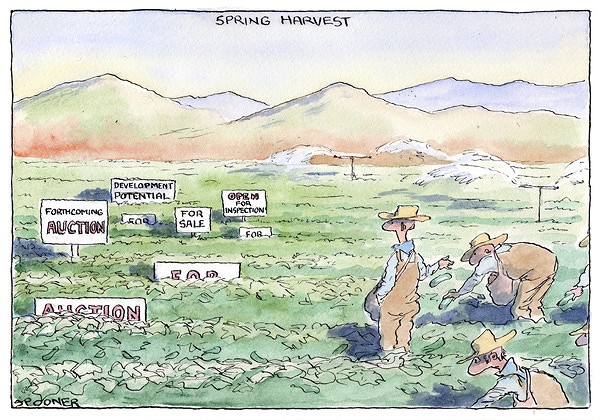
There is little to no sense of an urban policy designed to contain sprawl development. In fact, the sense is one of the continuing hegemony of the sprawl land development paradigm as population growth is placed at front and centre of the Rann Government's economic development and urban design plan--Adelaide 2038. Many people in Adelaide continue to think public transport is a second rate transport option.
The development lobby and the Coalition say that Australians have to accept that urban sprawl is the price they have to pay for affordable housing. The developer's promise is an affordable house and land packages-- the housing dream --on the urban fringe. This requires a steady supply of urban land and ever more freeways to avoid gridlock.
Behind the promise lies the reality of social disadvantage. Adelaide is a city divided by socio-economic fault-lines and entrenched inequality. As the former SA state planning minister Jay Weatherill conceded:
We drive low-income people out to the city’s extremities where services are the most stretched ... The paradox is that governments unwittingly subsidise this sprawl … A Perth study has found that the direct cost to government of providing infrastructure for a fringe block is more than three times the cost of an inner block … So we have a situation in which government is providing high subsidies for low-income people to live in fringe areas where services are low and where building communities is hardest....The paradigm of cheap land on the fringe of the city no longer exists and, in fact, has not for many years. The true cost of urban sprawl has been masked through cross-subsidisation of infrastructure by governments.”
This form of urban sprawl is not just in Adelaide. Melbourne is the same. Plans to contain Melbourne's urban sprawl are "stone dead", the city's green wedge zones are in danger, and urban planning is led by the development community with the Government just rolling over.
In both cities there is urban encroachment (houses and expressway ) on prime agricultural land which threatens the state's food security and export ability at a time when climate change also threaten the sustainability of horticultural industries (eg., in the Adelaide Hills). This will continue --eg. the Rudd Government's thirty year plan for the future forecasted a projected growth in population of 560,000 with most expected to push out of the city limits and into the north, expanding to the Gawler region. The once regional town will be transformed into a metropolitan super-town that impingeson the Barossa winegrowing region.
The Australian Institute of Architects, the nation's peak architectural body wants Australian cities to focus on boosting their inner and middle suburbs' density rather than release land in outer areas, in order to become more sustainable. Rightly so because car obsessed, low density suburban Adelaide is not a compact city, and it is probably not sustainable in its present configuration in a heated up world.
Posted by Gary Sauer-Thompson at 7:12 AM | Comments (16) | TrackBack
November 16, 2009
fruit loops + talking shops
I watched Question Time in the Senate today on the ABC. It was dominated by questions about refugees and climate change, with the background wall of noise and interjections from the Coalition loudest on the issue of climate change. Their strategy is one of obstruction.
I have to admit I'm utterly sick of the "know nothingness" of the National Party--denialists one and all--give the decline of the agricultural economy. There is the slow destruction of irrigated agriculture in the southern Murray-Darling Basin from lack of water-- so similar to the decline in Central Valley, the thin, fertile band running down the middle of California. and the negative impact on cropping( wheat) agriculture. The Nationals looked and acted like fruit loops. They are in hock to the nation’s coal industry in NSW and Queensland.
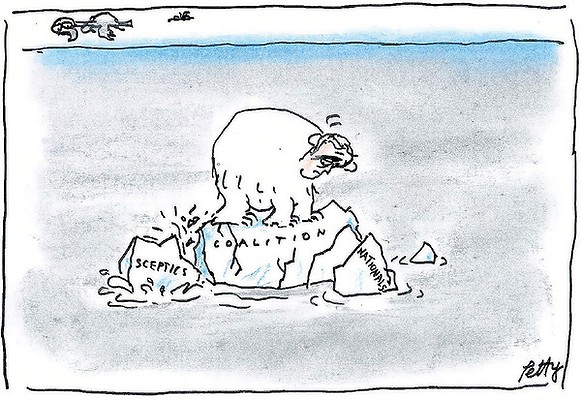
Senate leader Nick Minchin warned that the Rudd Government's backdown on including agriculture in the scheme was “necessary but insufficient” and a long way from delivering enough concessions for the Coalition to support the legislation in its current form. He also warned that Labor could agree to all of the Coalition's amendments and the Coalition could still vote against the government's legislation.
According to Nick Minchin's Liberals it's all a left wing conspiracy and a fraud cooked up by communist greenies intent on destroying the Australian way of life. Or something crazy like that.This economic ruin talking point indicates that truth and science is of no concern to them. So that leaves political advantage.
They reckon that their advantage lies in opposing the government’s emissions trading scheme, even though the Riverland in SA is experiencing the long term impact of farming a region that cannot sustain the current irrigated agricultural practices. It's future is a dust bowl. Just wait for Copenhagen Minchin's Liberals say.
The time has run out to secure a ‘grand global bargain’:--- a legally binding climate deal at the Copenhagen summit in December that was meant to lock in place a global action plan to replace the Kyoto protocol. As there has been lack of progress in recent preparatory talk Copenhagen becomes talks about talks to secure binding emissions targets and overcome the divisions between the developed and developing world. There has been failure to agree on the big issues: what carbon cuts rich countries should make, how much money the poor should get to help them adapt to climate change, and where that money should come from.
The US, Australia and Europe are playing hardball to split the developing countries (G77) in order to weaken their political positions and isolate them before they make them offers (promises of cash soon and greater reward later) and get their way.
There is no Copenhagen deal because of the hold-up of the climate legislation in the dysfunctional US Senate. There the Republican minority has taken obstruction to a new level in that their strategy is to insure that Democrats fail to accomplish anything.
Posted by Gary Sauer-Thompson at 2:34 PM | Comments (11) | TrackBack
November 15, 2009
Australia's coasts + climate change
Climate Change Risks to Australia's Coasts reinforces the House Standing Committee on Climate Change, Water, Environment and the ArtsInquiry into climate change and environmental impacts on coastal communities that I mentioned here. The former report is Australia's first national coastal assessment, and it brings together existing and new information to highlight the scale of problem Australia faces as a vulnerable coastal nation.
It states that there is an increasing recognition that sea-level rise of up to a metre or more this century is plausible, and possibly of several metres within the next few centuries. 1.1 metres was selected as a plausible value for sea-level rise for the risk assessment based on IPPC science, and these sea levels will bring significant change to Australia’s coastal zone in coming decades:
With a mid range sea-level rise of 0.5 metres in the 21st century, events that now happen every 10 years would happen about every 10 days in 2100.The current 1-in-100 year event could occur several times a year ... With much of Australia’s infrastructure concentrated in the coastal zone around centres of population, climate change will bring a number of risks to built environment assets.
Queensland stood to be the worst affected (Moreton Bay, Mackay, the Gold Coast, Fraser Coast, Bundaberg and the Sunshine Coast), then NSW (Lake Macquarie, Wyong, Gosford, Wollongong, Shoalhaven and Rockdale), then Victoria (Kingston, Hobsons Bay, Greater Geelong, Wellington and Port Phillip).
In SA the most vulnerable area to a sea-level rise of 1.1 metres, is Port Adelaide, which is located between the Gulf St Vincent and the Port River near Adelaide, and which is experiencing local land subsidence, due to wetland reclamation and groundwater extraction from the aquifer. It will require the construction of a system of sea walls to protect against inundation.
Yorke Peninsula is also vulnerable, followed by the Kingston and Robe region of the southern coast and the Glenelg foreshore in Adelaide. In spite of this vulnerability the Department of environment and Heritage's 2004 Living Coast Strategy makes no mention of rising sea levels.
It is on the radar of SA Coast Protection Board as there is a long history of allowance for sea level rise in local planning in South Australia Current provisions for sea level rise in development plans around the state allow for sea level rise of 300 mm over 50 years, plus the capability of being protected against further sea level rise of 0.7 meters, using protective measures such as sea walls and setbacks.
Update
The proposed emissions trading scheme, which has been diluted by huge concessions to incumbent power producers, exporters and mining companies and in all probability will be further diluted by excluding agriculture from the scheme ''indefinitely'' will make no difference to rising sea levels. In contrast, US farmers are benefiting from a voluntary cape and trade scheme. A low level mitigation means greater adaptation.
Ziggy Switkowski in his We are already adapting to warming in The Australian says:
And when reports suggest that hundreds of thousands of homes and many billions of dollars of property will be at risk from surging tides this is not necessarily a consequence of rising sea levels but a result of population growth and our inclination to locate ourselves and our expensive belongings ever closer to the coast....Changes in sea levels have not translated into observable changes in insurance claims associated with coastal and riverine flooding....To be sure, annual aggregate insurance costs continue to rise sharply but so far these are caused by societal factors and not anthropogenic climate change.Our continent is especially vulnerable to meteorological hazards so climate-driven shifts should be detected early and none has been, yet.
Coastal flooding is caused by societal factors? Really? Floods, cyclones and bushfires have now become such a fixture of the insurers' landscape that they can no longer be viewed as one-off incidents. They are now seen by insurance companies as an effect of climate change on our weather patterns and this results in a repricing of risk by insurers. That means increasing premiums, not just for beach houses but for towns and cities.
Update
It's not just Pacific Islands, beach houses and remote Arctic outposts falling into the sea. Have a look at these images of Shishmaref village on Alaska's remote west coast, which reveal the tip of a permafrost terrain melting very fast.
Posted by Gary Sauer-Thompson at 8:07 AM | Comments (2) | TrackBack
November 14, 2009
Media present is a hybrid of old + new
A debate or conversation about the future of news media between "old" and "new" media at the Monaco Media Forum between Mathias Dopfner, CEO of German media giant Axel Springer and Arianna Huffington of the entrepreneurial media start-up Huffington Post in the US.
The consensus was that the present and the future is a hybrid reality in the linked economy --- a mixture of paywalls, newspapers, broadcasters and advertising financed online media. The future is digital, the emphasis is on content provision, and there is a diversity of the distribution of content in a decentralized, opened economy.
There is always something that flows, that escapes the overcoding machine, as Deleuze would put it. Hybridity is a figure for the breakdown of all kinds of boundaries and categories and with new lines appearing to be drawn, there are new ways of playing with the fragments.
Suprisingly, it was also agreed that there is a crisis of journalism due to critical content failure (eg., the Iraq war and the global financial crisis), and not one due to the technology of the distribution channels. On those two major events the journalists failed to live up to their professed standards and were content to spin for the those in favour of war and Wall Street. There was little analysis or investigative journalism.
This is then associated with a growing concern about how we fund quality public service/accountibility journalism--seen by many to be on par with our transportation infrastructure, the social safety net, public universities---in the future. Highspeed broadband for all is the first step.
Update
In Australia the circulation of the corporate national media (the AFR and The Australian) continues to slip and their revenue to decline. The newspaper and commercial broadcast executives continue to argue that the advertising declines are cyclical, and that the advertising future will magically brighten when the overall economy returns to prosperity from the mining boom.
The economic reality is that the advertising won't return to the same levels as before, the newspapers will become much smaller operations (laying off people and scaling back) and Fairfax will struggle to service, and to roll over, its $1.8 billion debt.
Posted by Gary Sauer-Thompson at 12:06 PM | Comments (4) | TrackBack
November 13, 2009
miners wind up the good time spin, again
As I was returning to Adelaide from Victor Harbor this afternoon I tuned into ABC's PM and heard I Andrew Forrest, the boss of Fortescue Metals, talking up the economic boom in the global economy.
This was no road to recovery narrative. It is boom time folks narrative. China's taking off big time and that will cause America and Europe to lift off. We--in Australia--- are going to see a boom like we have never experienced before.

What's Forrest spruiking now I thought, cos China just isn't going to save the world. True, the US is an economically battered superpower, is heavily financially indebted to China, has huge trade and budget deficits and it needs to undergo structural change.
It is also true that Asia is becoming the centre of gravity of the world economy and an engine of global growth. This means, as an editorial in the Financial Timespoints out, that:
a move back to healthier US public finances depends, inescapably, on a strong recovery in the US economy. US policymakers cannot achieve this on their own. They need help. It is in the long-run interests of Asians to provide it.
Growth in the US economy depends on increased exports not more consumer debt bubbles, and that means dollar depreciation.
Alan Kohler points out in Business Spectator, that China cannot save the world because:
the model on which China’s growth has been based for 30 years has now ended because the debt-funded consumption boom in the west, particularly America, was unsustainable. China’s rate of economic growth will slow, he says, from the 10 per cent average of the past 30 years to 8 per cent over the next decade and then 5 per cent after that.
China used to rely on exports to the US before the global financial crisis, now it must shift to the driver of domestic consumption. However, the structure of its domestic economy does not permit it. Kohler points out that:
two things need to happen at once for a dramatic increase in Chinese consumption: corporate ownership reforms that would force more profits to be distributed to the people and more political democracy so that the Chinese leadership is driven to distribute more money in the form of welfare transfers.In other words the unelected political and corporate elites of China are hoarding the cash. Unless they let go of it, China won’t become a consumer society. And with the export model dead, that means lower growth and lower commodity imports.
Forrest is off with the fairies, if he is not simply spruiking for big time Chinese investors to put some cash into his operations.
Posted by Gary Sauer-Thompson at 6:01 PM | Comments (1) | TrackBack
November 12, 2009
Media140 Sydney revisited
There are blog posts and reflections about Media140 Sydney's "future of journalism" conference now surfacing on the internet. These reflections are taking steps beyond the immediate comments on the day by both journalists and bloggers
These start from an acceptance that the media industry is changing dramatically, that journos are rapidly getting into online media and engaging with social media. One of the more interesting is that by Neerav Bhatt. In The future of journalism in 140 characters on the ABC's Unleashed forum he steps beyond addressing:
the well-worn arguments about bloggers vs. journalists, media outlets sacking journalists by the hundreds, the demise of newspapers and erosion of free-to-air TV audiences that threaded themselves through the conference.
He suggests that we work our way through the 10 points that constitute Jay Rosen's important Rebooting the News System in the Age of Social Media which formed the basis for his keynote address.
If you weren't at the conference, or watched the live feed of the keynote, then you along with me need to work our way through these 10 points, as they form a complex layered interpretation of what is happening in the global mediascape.
It was a significant keynote address and we in Australia are engaging with, and interpreting, his work in terms of its significance for us within the Australian mediascape. In the earlier post I'd picked up on point one on audience atomization in the closed system with its one-to-many world.
There Rosen argues that the press was able to define the sphere of legitimate debate with relative ease because the people on the receiving end were atomized-- connected "up" to Big Media but not across to each other. I observed that:
Telling our stories means challenging the way the media maintains boundaries around the sphere of legitimate debate; undermining the way that what Jay Rosen calls the “ground” of consensus is established by the professional political class in Canberra, and then offering that tightly bounded consensus to the country as if it were the country’s own.
Rosen points out that what’s really happening is that the authority of the press to assume consensus, define deviance and set the terms for legitimate debate is weaker when people can connect horizontally around and about the news.The atomization effect is overcome.
Rosen's second point is that though closed and open platforms and editorial systems (the press and the social media sphere) are different, they are not separate things. They are richly interactive with one another in the news and information marketplace.They are also interactive in terms of media values such as neutrality, trust, ethics and transparency.
The third links to Dave Winer's interpretation of a newspaper'snews process within this new mediascape. The New York Times is not:
not the printing press, the trucks, or even the editors and reporters. It is the logo and the tradition, the history. Whatever the Times does, it must not diminish the value of the brand, it must enhance it. The challenge is to tap into the enormous potential of the Internet as a news creation and delivery system ...To understand how news works, you need to visualize a flow diagram that includes all the elements of the news process. All the people, not just the reporters and editors. That's where the growth is going to come from.
So basically the Times must evolve, just a little, to see their sources not just as quotes, but also as reporters with a beat -- their expertise. If bloggers get their ideas from news people, then the news people get their ideas from bloggers, including a lot of the bloggers they don't like are also sources. It also means that the newspaper gets a person (ie user generated content) to cover an event for them.
The fourth point picks up on media technologies enabling people to become citizens and the significance of the shift from one-to-many communication (broadcaster) to a many-to-many network using digital media. The argument is that those persons, who were once the audience or readers of the media, are now using the press tools (blogging, podcasting, the Web, cheap digitial cameras, desktop editing) to inform one another about newsworthy events.
This is citizen journalism. They don't need the press to talk to, and inform, one another online. This is a shift from one-to-many communication (broadcaster) to a many-to-many network using digital media. This is about public, civic, citizen participation not just about helping news operations at Fairfax of News Ltd to get a free staff or develop better coverage.
'Citizen' make the link to a political culture and democracy, which in Australia is liberal democracy and brings into play all the historic tensions between liberal and democracy and the way that liberalism represents democracy.
Posted by Gary Sauer-Thompson at 9:01 AM | Comments (1) | TrackBack
November 11, 2009
a note on Australian conservatism
The recent conflict over an ETS in the Liberal Party raises a question about Australian conservatism. It currently celebrates itself as being healthier than it has been for many decades and usually understands itself in terms of the conservatism of Burke, who highly valued prudence, tradition (custom and habit) and civil responsibility. Or it represents opposition to the Labor party and political correctness in the form of a polemical cultural politics.
My stab at Australian conservatism is rather different. A core theme is that Australia is in peril from terrorists, refugees, the ETS, greenies etc) and that conservatism is the only reliable savior from the darkness that surrounds us. It speaks for mainstream Australia.
One strand of conservatism equates the welfare state with totalitarianism as the centerpiece of its ideology. Social Security is somehow akin to a gateway drug that first destroys self-sufficiency, then created dependence on big government, and finally results in a totalitarian state that destroys individual freedom. The government itself is an enemy and this is what lies at the heart of modern conservatism's hostility to centralizing sovereign government in the nation state. Think Hayek and the IPA.
The social conservative stand, based in Christianity, (the uglies) which has a narrative that Australia is Rome, the Huns are at the door, and instead of summoning strength, determination, and righteousness, we are wallowing in self-indulgence, decadence, and denial. The reason for this is modernity. It sucks. Think Cardinal Pell.
Thirdly, the modern conservative movement has always seen itself as a populist insurgency against both the chattering elites or classes (in Carlton, Fitzroy and Balmain etc) and the untrustworthy [Labor] leaders endangering the nation.The people (authentic or true blue Australians) are the saviours --they have commons sense --ie., wisdom and virtue of Australian to save Australia. Think Alan Jones.
These three strands-- and there may be more-- are pretty standard---ie the social conservatism vs economic liberalism assemblage noted by many commentators. I want to step away from this in order to start to explore how these coalesce around a critique of Australian liberalism. This different approach will help us to see the philosophical core Australian conservatism rather than a political movement based on conflicting strands.
One front of this critique is that conservatism favours homogeneity (an Australian ethos or a common Australian culture) and the eradication of difference or heterogeneity (multiculturalism) in the name of assimilation and restriction on unwanted immigrants through its immigration laws.
The charge against liberalism is that liberalism promotes a civically divisive pluralism and that the public sphere is little more than the chattering classes indulging their narcissism to unending discussion or ever lasting conversation. Decisive decisions on tough issues are what is needed--not endless chatter. This leads to the existential unavoidability of exceptional emergency situations (the state of emergency) and the necessity of an unaccountable sovereign defending/guarding the Australian people from external threat in unusual and threatening times.
Think Tampa and the war on terror with its existential friend and enemy distinction and the extension of ASIO and police powers to preempt terrorism. The actions of these guard dogs were accountable only to the executive (the sovereign). The executive is the guardian of Australian citizens and we owe our allegiance to the executive (the sovereign)--- not Parliament in exchange for this protection.
This is quite different from, and in opposition to, liberal constitutionalism. The buried assumption is that there is a need for an external enemy or a foe in order to secure a political order and the social cohesion (or homogeneity) within that order.
Update:
I explore deeper into the conservative critique of liberalism over at philosophy.com since it steps beyond the politics to philosophy that in turn opens up potent political territory around the Conservative understanding of society.
Posted by Gary Sauer-Thompson at 5:18 PM | Comments (17) | TrackBack
November 10, 2009
a Liberal Party madness
I wasn't planning to watch the last Four Corners programme entitled Malcolm and the Malcontents attributed to Sarah Ferguson. Not another account of Liberal Party disunity I thought. We know that the conservative and liberal wings are at war. But I was persuaded by the flow of interesting comments on Twitter.
The Coalition sure is a rabble over climate change despite an ETS scheme being their policy. The Nationals are totally opposed and conducting a fear and loathing campaign in regional NSW and Queensland. It's a no vote, absolutely. They reckon they'd win a double dissolution election on opposing an ETS.
The conservative populist rhetoric is that an ETS is "socialist chardonnay rubbish", a left-wing “conspiracy”. There is no global warming, just natural cycles and the appeal to justify this is to 'sense' and 'impression' and pre-existing sentiment (common sense) of the hard done battler. The Nationals have drawn a line in the sand and put their bodies on the line to fight green fanaticism that is taking over Australia. They look such a rag tag bunch, as does their white populist base. They all looked like the One Nation party of the1990s, sadly haunted by the decay of their wizened provincialism. Death beckons.
In the Liberal Party Minchin, Abbott, Jensen, Kormann, McGauran and Bernardi, climate deniers one and all, were openly opposed to an ETS, quite willing to oppose their leader publicly, and to do so on the lefty ABC. Minchin, in particular, was claiming that a majority of the party did not back Mr Turnbull's acceptance of the science behind climate change, and openly encouraging the backbench to defy their leader on this issue.
All this is at a time when the Coalitions' party room has authorized Ian McFarlane to conduct good faith negotiations with Minister Wong to work through the Liberal Party's proposed amendments to the Government’s CPRS legislation now in the Senate.
McFarlane was the only Liberal who came through with any political nous. He was using political reason to think the issue through---he “is no longer sceptical about humans causing global warming but he is now sceptical about carbon capture and storage”--- and to see the Coalition through a very difficult patch. In the meantime the climate change deniers, one and all, have rejected the scientific enlightenment and, just like the Republicans in the US, fully embraced the contemporary form of the counter Enlightenment tradition.
Update
Minchin knows that the failure to get the Liberal Party on side on an ETS will almost certainly end Turnbull's leadership, and he is nakedly acting to make that happen. But for what goal? The disunity strategy is a pathway to many a long year in opposition. That would provide him with an opportunity to continue with the factional politics within the Liberal Party--to clean out the liberals (wets) and replace them with conservatives so that the Liberal Party is liberal in name only? That has been his strategy with the SA Liberal Party. Is this his game plan?
Posted by Gary Sauer-Thompson at 8:20 AM | Comments (19) | TrackBack
November 9, 2009
Murdoch: you're stealing my stories
The Sky News interview with Rupert Murdoch by David Speers is below. In it Murdoch mentions his opposition to fair use. He reckons that it can be challenged and changed in the courts. I presume that means applying copyright to news.
Murdoch has an old-fashioned vision of the value of journalism and one core message is that he is determined to ensure that the ABC and BBC pay for using News Corp's stories. Currently, the public broadcasters are amongst the:
people who simply pick up everything to run with, and steal our stories ... they just take them .. without payment ... If you look at them [BBC] most of their stuff is stolen from the newspapers now, and we'll be suing them for copyright.
He's sabre rattling on this. All Google News offers is a headline and a link to via a click over to one of his sites. That’s theft? Stealing? Murdoch gave what to Google? A headline where people could go to his web sites for more information. However, Murdoch really does want to hobble the ABC and the BBC. They need to be shrunk to limit what they place in the public domain so that News Corp can make more money from its online products.
Everybody's going to pay me for my content is the other core message from Murdoch. Of course, nothing was said by Murdoch about his media organizations making use of fair use of the work of others for their stories (eg., the images of the Sydney dust storm) Nothing at all. It's his entitlement, as it were, including ripping off Four Corners.
From Rupert's perspective everybody is just stealing from Rupert. It's piracy. End of story. He sounds just like the old music industry. Even if he understands how markets work, the 'piracy' implies copyrighted content. But news is not copyright. It does appear that he has joined Big Content's 'anti-piracy' campaign. For Murdoch we can have the first paragraph of his quality editorials and scintillating commentary for free. If you want anything else, then you pay.
On the fair use message Murdoch does not reckon that he should consider fair use of his content, which allows for limited use of copyrighted materials without permission so that we can put our content into the public domain. Fair use for Murdoch is the right to hire the lawyer.He doesn't like it so he'll be abolishing it shortly. So how is Murdoch going to kill off fair use through the courts? What is left for the public domain after the threat of potential legal action for 'copyright infringement'?
Fair use is a statutory exemption to the rights of copyright owners and there are four key factors that help decide whether use of copyrighted material constitutes fair use: (1) the purpose of your use, (2) the nature of the work, (3) the amount you're using, and (4) the effect of your use on the market. Copyright, despite its name, came into being as a set of liberties for the public as well as a set of rights for the author. The three most important liberties are the liberty to use ideas, the liberty to use facts and the liberty to make a fair use of expression from prior works.
It is difficult for people to use all of the liberties that the law provides because you need to have the physical, financial and emotional wherewithal to use them. You know the old line, “the rich and the poor are equally free to sleep under bridges”? However, you don't need a lawyer to take advantage of some of the liberties provided by copyright. Hence the idea of the creative commons with its Web.2 ethos of share, remix and reuse. It is this culture that Murdoch is opposed to.
He has little concern for public good function. His strategy is that the more he can choke off the internet as a free news medium, the more publishers he can get to join him, then the more people he can bring back to his papers, and the more people he can get to pay for use of his content. The internet for Murdoch is a toll booth with him in the collector's seat.
Posted by Gary Sauer-Thompson at 6:12 PM | Comments (18) | TrackBack
journalism + new media
Derek Barry has a couple of posts on the new media, journalism as a critical public good and the Woolly Days weblog. It moves away from the old meme of the new media is bad, and journalism is dead "debate" that has gone for several years in Australia. Most of the spin aims to further the divide between old journalism and new media in order to shore up the journalist supremacy of the old media.
In his latest post Barry states:
With Murdoch-led paywalls on their way, it is crucial that ABC journalists have the right tools available to them to provide a useful free-to-net alternative for those unable (or unwilling) to afford to buy their news. .... social media, blogs and user-generated content are not replacing journalism, but they are creating an important extra layer of information and opinion. Most people are still happy to rely on mainstream news organisations to sort fact from fiction and provide a filtered view.
I concur with the layers account, but I'm not sure that the pay walls scenario is just about buying news. It is more corporate media's shift away from accountability journalism because the ad-supported newspapers can no longer afford the public good of accountability journalism. Hence the importance of public media and the creative commons.
As Clay Shirkey says in talk at the Shorenstein Center on the Press, Politics and Public Policy at Harvard University:
What the Internet does is it makes all commercial models of journalism harder to sustain — not impossible, but harder. And it makes public models easier to sustain — partly because of the lowered cost, partly because of the [inaudible]. And it makes social models much, much easier. So we’re seeing, I believe, a rebalancing of the landscape in terms of the logic of the creation of public goods away from a market dominated by commercial interest into a market where all three of these modes of production are going to be operating side by side in different ways.
It is less a question of replacing newspapers than ensuring the continuation of accountability journalism in the new mediascape, given the decline in this kind of journalism.
Barry's understanding of this new mediascape in formation is that the old battle between old and new media is misplaced in that the blogging publishing platform and Twitter are becoming of new mediascape. Referring to the Media140 Sydney conference he says:
the battles that dominated the backchannels this week reminded me of similar warfare waged two years ago. In September 2007 I attended the first (and to my knowledge, still only,) Australian Blogging Conference in Brisbane. Much of that conference focused on blogs and political reportage. Bloggers and academics lined up on one side of the argument describing how blogs were a crucial part of the public sphere. On the other side professional journalists reminded them that blogging was a practice as well as a platform and their craft skills were still needed to provide proper context to whatever information being made public.The journalists had good reasons for their turf minding – they feared their role as sense-makers was about to be seriously diminished.
He adds that two years latter it is obvious that the old battle over blogs either saving journalism or walking all over its corpse has become history. I concur. It was a battle over nothing much. Barry says that it is Twitter that is now causing the most professional angst:
what did come out [at Media140 Sydney] was the same battle between new and old media along traditional lines but in a new technology. The early adopters and academics showed how Twitter was changing the news landscape. Once again the journalists asserted their right to provide an ethical, informed and contextualised take on the news in the new platform. It was the 2007 arguments all over again but with a new technology. I suspect the outcome will be similar.
As Sharkey points out it is it’s possible for people to agree about the irreplaceability of newspapers, but to disagree about how serious the change in the media environment is. Those changes and their future significance is where the core debates are.
My judgement is that there is a significant revolution is taking place in media production (its not just a cyclical downturn) and the old models are breaking up faster than the new ones are being put into place. What comes to the foreground with respect to public media goods is the nonprofit media organizations that operate in a commercial environment--eg., the ABC and small online magazines. The ABC is doing all right. It is the survival of the small magazines that is a concern.
Posted by Gary Sauer-Thompson at 6:56 AM | Comments (6) | TrackBack
November 8, 2009
a food policy?
As Michael Pollan points out in The New York Times, our industrial food system is now characterized by monocultures of corn and soy in the field and cheap calories of fat, sugar and feedlot meat on the table. It has enabled an Australian to be able to go into a fast-food restaurant and to buy a double cheeseburger, chips and a large Coke for a price equal to less than an hour of labour at the minimum wage.
However, the food and agriculture policies we’ve inherited from the industrial-food system, which were designed to maximize production at all costs and relying on cheap fossil fuel energy to do so, are in difficulties. There is a need to address the problems they have caused: excess production pollutants, lack of water, junk food, antibiotic-resistant bacteria in our food supply, and ever increasing public subsidies to prop up the old system of maximizing production (get big or get out) from a handful of subsidized commodity crops grown in monocultures.
The rise of markets for alternative kinds of food (organic, local, regional) indicates a shift away from cheap convenience foods full of fat and sugar, whilst the environmental or public-health price keeps increasing during a time of climate change. Time to rethink the way we produce food? Time to question industrial style food?
Pollan, who is the Knight Professor of Journalism at the University of California, says:
As I write, the FDA has just signed off on a new health claim for Frito-Lay chips on the grounds that eating chips fried in polyunsaturated fats can help you reduce your consumption of saturated fats, thereby conferring blessings on your cardiovascular system. So can a notorious junk food pass through the needle eye of nutritionist logic and come out the other side looking like a health food.
The smart thing to do, he argues, is stay away from any food that trumpets its nutritional virtues, since:
for a food product to make health claims on its package it must first have a package, so right off the bat it's more likely to be a processed than a whole food...The genuinely heart-healthy whole foods in the produce section, lacking the financial and political clout of the packaged goods a few aisles over, are mute.
At the policy level there should be a change from the policy to shrink the number of farmers by promoting capital-intensive monoculture and consolidation to building the infrastructure for a regional food. There needs to be a ban on the routine use of antibiotics in livestock feed on public-health grounds, now that we have evidence that the practice is leading to the evolution of drug-resistant bacterial diseases and to outbreaks of E. coli and salmonella poisoning.
Thirdly, confined animal factories should also be regulated like the factories they are, required to clean up their waste like any other industry or municipality. It is a shift to a more sustainable agriculture. Fourthly that the health minister should take over from the Department of Agriculture the job of communicating with Australians about their diet. Pollan says:
That way we might begin to construct a less equivocal and more effective public-health message about nutrition. Indeed, there is no reason that public-health campaigns about the dangers of obesity and Type 2 diabetes shouldn’t be as tough and as effective as public-health campaigns about the dangers of smoking. The public needs to know and see precisely what [Type 2 diabetes] means: blindness; amputation; early death. All of which can be avoided by a change in diet and lifestyle. A public-health crisis of this magnitude calls for a blunt public-health message, even at the expense of offending the food industry.
Fifthly, the industrial agricultural system should be exempted from an emissions trading scheme designed to increase the cost of using cheap fossil fuel.
Posted by Gary Sauer-Thompson at 7:57 AM | Comments (22) | TrackBack
November 6, 2009
restoring the River Murray?
As we know the rivers and wetlands in the Murray-Darling Basin experience water scarcity because state governments divert too much water primarily for irrigation. This is the over-allocation problem that the federal government is struggling to fix.
Richard Kingsford, the director of the Australian Wetlands and Rivers Centre, University of NSW, is optimistic. He says in the Sydney Morning Herald that:
Australia has embarked on one of the world's most ambitious river restoration efforts for the Murray-Darling Basin.It is the equal of restoring the Florida Everglades, flooding the northern part of the Aral Sea, or even re-engineering the Rhine for salmon. It is massive, yet we don't know if it will work.
Whilst this is true disagree with his optimism. We do have a lot of moving rhetoric about river restoration, but there is little in the way of action or increased environmental flows in the River Murray.
It is also true that the federal government has begun to buy back some water. But there is no attempt at all to systematically prioritise wetlands, estuaries and rivers assets for conservation and restoration management; or to remove weirs, levees and other water management infrastructure that significantly fragment river, wetland and estuarine habitats, disrupting movement of animals, dispersal of plants and altering water quality.
As Kingsford himself points out:
The National Water Commission was scathing this month of the states' inability to deal with over-allocation. More than 40 per cent of water plans were not in place and even some in place were not operational. Recent behaviour by the states shows why rivers and borders don't work. NSW shut up shop to further federal buy-backs of environmental water in June because too much of its water was going to the environment. Victoria remains the spoilt child of the family, with its what's-mine-is-mine attitude: it allows only 4 per cent of its water to be bought and transferred out of the state in any one year.
SA is giving any increased water to its irrigators whilst Queensland is activating sleeping/dozing allocations on its rivers in the Basin.
The Murray River has become a series of pools of water for irrigators; a long irrigation channel if you like that is being defended by fair means and foul. So why the optimism, given that Kingford knows all the above? He says:
Let's hope Australia can show the world that not only are we good at reviving our rivers, but we know what we are spending it on.
Kingford only hopes that we are reviving the health of our rivers. Maybe it is good to have hope that the overallocation problem will be fixed when history indicates otherwise.
Posted by Gary Sauer-Thompson at 6:55 AM | Comments (17) | TrackBack
November 5, 2009
Media140 Sydney
There is a Media 140 event happening in Sydney over the next two days, with a live stream, live blogging, and real time twitter. Though the concern is with the impact of social media on journalism the focus is on twitter. The conference format is a mixture of keynote speeches and panels with speeches plus questions at the end. It was all text based journalism with no mention of photographers.
There is still a fear of, and disdain for, the social media being expressed by various media conservatives (eg., the ABC's Chris Uhlman and Robyn Williams from the ABC Radio National’s Science Show) but the bashers of Bloggers/Facebookers/Twitterers were in a minority. There were constant references back to objectivity and the essence of journalism (the truth?), journalism as a profession, and journalism in the grand investigative style. However, the emphasis was more on the new social media. Malcolm Turnbull was the only politician to speak and he spoke about getting the message out across all platforms. That challenges McLuhan.
Mark Scott,, managing director of the ABC, kicked things off this morning by saying that the ABC is reinventing itself from a rigid institution based around a static collection of platforms to becoming a generator, commissioner, distributor and enabler. So it is interpreting the social media as "consumer" empowerment, social interaction, dialogic ethics and ongoing conversations.
Scott, who comes across as an industry leader, spelt this out in two ways. Firstly, the development of the digital townhall concept (now the ABC Open Project) that was connected to 50 digital media producers stationed in ABC centres with a brief to work with local communities to help them create their own media. This depends upon the development of high speed broadband through the National Broadband Network.
Secondly, there will be the launch of “ABC Widgets” that will allow anyone to run ABC news feeds on websites and social networking pages. This will position the innovative ABC in the centre of the digital mediascape, and probably as the key player. This was the only substantive mention of "the audience" for most of the day. What was never addressed was deciding what does and does not legitimately belong within the national debate was a political act.
The context of this reinvention of the ABC is that the economics of the internet is impacting heavily on the industrial age media factories--it is pushing the financially threatened Fairfax media o the edge, and is forcing News Ltd to go behind the pay wall with its product linked to a Kindle or Apple Tablet type platform. Both these media factories miss the consumer empowerment of the internet, in that this new technology enables people to have "human to human" conversations, which have the potential to transform traditional business practices radically.
Jason Wilson, one of the morning panelists, deflates the signifance of Twitter "revolution":
There are some fallacies of futurology that recur when new media arrive. New media are always seen as superseding their predecessors, but very few media technologies disappear from use in any simple way. They persist alongside emerging ones, because they still have applications. New media are always seen as more transparent, but when we settle down we usually realise that no medium is a pure avenue of information; each one is used to select and frame events in specific ways. New media are often seen as democratising, but what do we mean by that exactly, beyond a normative endorsement? In fact, new media tend to gather unique publics, and there's enough research about social networks now to suggest that they have specific audiences, and are capable of exclusion as well as inclusion.
The key here is not the technology per se, but the way the social practice of journalism is being changed by the new social participatory media, and how it gives rise to different forms of writing (images and text) across a variety of media platforms. These forms of writing are expressing our content and our stories. These are narratives from below, and they are the democratising bit.
Media conservatives, of course, reject this. Thus Ben Macintyre in The Times says:
Click, tweet, e-mail, twitter, skim, browse, scan, blog, text: the jargon of the digital age describes how we now read, reflecting the way that the very act of reading, and the nature of literacy itself, is changing.... The internet, while it communicates so much information so very effectively, does not really “do” narrative. The blog is a soap box, not a story. Facebook is a place for tell-tales perhaps, but not for telling tales. The long-form narrative still does sit easily on the screen, although the e-reader is slowly edging into the mainstream. Very few stories of more than 1,000 words achieve viral status on the internet.....Narrative is not dead, merely obscured by a blizzard of byte-sized information.
Surely there will be new opportunities for storytellers to work with each other and share their tales with broader audiences online. Isn't that what the "passive audience" becoming user generators means in the context of the social media?
Telling our stories means challenging the way the media maintains boundaries around the sphere of legitimate debate; undermining the way that what Jay Rosen calls the “ground” of consensus is established by the professional political class in Canberra, and then offering that tightly bounded consensus to the country as if it were the country’s own.
Posted by Gary Sauer-Thompson at 2:44 PM | Comments (10) | TrackBack
US: "state secrets" and executive immunity
I watched Michael Moore's documentary film Fahrenheit 9/11 last night. This is a dystopian view of the United States under the Bush Administration and is controversial because it is deeply critical of the Bush administration and its conduct of the Iraq war and the you're either with us or against us" model of argumentation of the conservatives.
So many conservatives have been willing to give the US government a pass on its awful treatment of prisoners taken during the "war on terror", and were even happy to support such treatment when meted out to American citizens. An example of "awful treatment" is a Canadian software engineer named Maher Arar. Glenn Greenward says that Arar was:
A telecommunications engineer and graduate of Montreal's McGill University, [who] has lived in Canada since he's 17 years old. In 2002, he was returning home to Canada from vacation when, on a stopover at JFK Airport, he was (a) detained by U.S. officials, (b) accused of being a Terrorist, (c) held for two weeks incommunicado and without access to counsel while he was abusively interrogated, and then (d) was "rendered" -- despite his pleas that he would be tortured -- to Syria, to be interrogated and tortured. He remained in Syria for the next 10 months under the most brutal and inhumane conditions imaginable, where he was repeatedly tortured. Everyone acknowledges that Arar was never involved with Terrorism and was guilty of nothing.
After a full investigation by Canadian authorities and the public disclosure of a detailed report the Canadian Prime Minister publicly apologized to Arar for the role Canada played in these events and the Canadian government paid him $9 million in compensation. In contrast, the US under the Bush administration refused to acknowledge ever having made any mistakes and blocked any inquiries in the name of state secrets.
The Second Circuit Court of Appeals in Arar v. Ashcroft concluded that Maher Arar has no right to sue US government officials. It held that even if the government violated Arar's Constitutional rights as well as statutes banning participation in torture, he still has no right to sue for the harm that was done to him.
National security is the justification:---U.S. government officials can torture without worry, because the security of the US might some day depend upon it. The Executive can use secrecy and national security claims to shield itself from the rule of law, even when it's accused of torture and war crimes.
The Court has become the handmaiden of the Executive when it should be defending the constitution and the rule of law and a structural check on the power of the Executive.
Posted by Gary Sauer-Thompson at 6:05 AM | TrackBack
November 4, 2009
Ken Henry: shape of things to come
The Secretary to the Treasury, Dr Ken Henry, delivered an important speech entitled The Shape of Things to Come for Australia: Long Run Forces Affecting the Australian Economy in Coming Decades to the Queensland University of Technology Business Leaders' Forum in October this year. Henry spells out what I've been haphazardly grappling with on this blog in a clear and concise way. It helps to clear away some of my fog.
The core statement is this:
As the Global Financial Crisis hit our shores, the Australian economy was in structural transition in response to four large, long term forces: (1) population ageing; (2) climate change adaptation and the prospect of climate change mitigation; (3) the information and communications technology revolution; and (4) the impact on Australia’s terms-of-trade of the re-emergence, as global economic powers, of China and India. Over the past year, the shockwaves from the global financial crisis have obscured the intensity and scale of these forces. But as growth resumes, they will re-assert themselves. And, as they do, the Australian economy will undergo a set of structural changes more profound than anything in its history.
He adds that over the past year, the shockwaves from the global financial crisis have obscured the intensity and scale of these forces. But as growth resumes, they will re-assert themselves. And, as they do, the Australian economy will undergo a set of structural changes more profound than anything in its history.
His argument is that Australia can look forward to a long period of unprecedented prosperity - provided we accept a raft of unpopular economic reforms that will hurt us, and don't seek to resist the change being thrust upon us. I'm more pessimistic than this.
Take the first structural trend. Henry says that Treasury had been thinking about population dynamics in terms of ageing and a rising dependency ratio, but there is now a need to factor in the long term projection for Australia’s population increasing from 28.5 million in 2047 to more than 35 million people in 2049 (due to higher immigration and increased fertility). That increase of 13 million people, or around 60 per cent, over the next 40 years, has implications for our cities (Sydney, Melbourne, Brisbane) and the environment.
How will the capital cities cope with a rapidly growing aged population? By expanding their geographic footprints at the same rate as in the past several decades, loading more cars and trucks onto road networks, continuing the traditional patterns of land use and using up natural resources. Climate change means a drier Australia, which in turns means ever more stretched water resources, the decline of the Murray-Darling Basin as a food bowl, and a population shift from the south east corner of Australia to the north. It means lots of public investment in infrastructure.
Judging by our previous history on managing water and biodiversity it will be more business as usual than adapting to climate change by the cities becoming more sustainable. the main reason why am I pessimistic is that the impact on Australia’s terms-of-trade of the re-emergence, as global economic powers, of China and India takes the form of the capital-intensive, mining sector dominating the economy, the structural decline of manufacturing, and flat to declining real wages outside the resource sector. Henry put it this way:
standard economic theory tells us that if the terms-of-trade remain at high levels, not only will the resources sector command more capital and labour, manufacturing and other industries whose relative output prices are declining will command less, even as our total stock of capital expands. Furthermore, as the factors of production are reallocated, the pattern of growth will be characteristic of what is often referred to as a ‘two speed economy’; and real wages growth and labour productivity growth will be weak – possibly even negative.
The resource sector, we should never forget, is fundamentally opposed to Australia mitigating and adapting to climate change and to the development of renewable energy. And the mining sector has captured state and federal governments to such an extent that they are able to shape the direction of public policy.
Posted by Gary Sauer-Thompson at 5:50 AM | Comments (9) | TrackBack
November 3, 2009
supermarkets, food, health
Jon Wardle and Michael Baranovic conclude their article in the latest issue of The Brisbane Line by saying that:
Health problems are no longer being caused by lack of access to food but rather by lack of access to foods that provide the most health benefit. We need to look at food provision in a more integrated manner that extends beyond just price. Until the issue of a competitive fresh food retail sector is seen as a public health priority, the significant and entirely preventable impact of poor nutrition on health will remain a millstone on Australia’s health policy.
Most of their article is about the lack of competition in the fresh food retail and grocery sector due to the dominance of the Woolworths/Coles duopoly in Australia and how to ensure healthier competitive practices.
What is assumed is that the food industry causes health problems, that a preventative health policy ensures an equitable access to healthy, nutritious food, and that there is a literacy amongst consumers about the importance of healthy food for their wellbeing.
What is not mentioned by Wardle and Baranovic is that in spite of the claim of selling fresh food the supermarket shelves are full of foods full of sugars, fats, refined starches, artificial sweeteners, preservatives, colours, flavours and other additives. As Rosemary Stanton observes in Crikey:
The vast array of foods ensures we over-eat. The average supermarket now stocks 1800 different snack food lines, more than 150 breakfast cereals (some more accurately described as confectionery), and an absurd choice of junk in aisles stocked with packet soups, sauces, biscuits and sugary drinks. Does it really make us happier or healthier to have 45 varieties of milk or hundreds of choices of yoghurt?.. there is an urgent need to reduce the national girth. The most popular call is for more physical activity. No one would argue with that. But we also need to find a way to encourage people to eat less.
And to encourage people to eat differently--to eat more fresh food rather than the junk foods that are high in saturated fat and sugar. Stanton adds that:
The usual cry of “they should be educated” doesn’t work in the face of so much abundance and strong marketing campaigns to get us to eat more. Food industry profits depend on us eating more. The food industry’s solution of more choice increases profits, but does nothing for obesity.
I am sure that the food and drinks industry will both actively lobby against the recommendations of the Preventative Health Taskforce that will impact of their profits; and reposition themselves as the true friends of public health and market themselves as selling healthy products.
No sales tax on sugary soft drinks and fatty foods would be one example that would not go down well the food industry. They would resist this for sure.
Posted by Gary Sauer-Thompson at 3:20 AM | Comments (21) | TrackBack
November 2, 2009
goodby media paternalism
As we know, the newsprint newspaper business model, as based on advertising, is fatally wounded because we are moving to an online world with the screen is gradually replacing ink-on-paper. Hence the declining circulation of print editions of newspapers.
Will print editions will become the supplement to the online editions and web journalism? Though the digital path is the one to take if local journalism is to survive and thrive in future, new for-profit models for supporting this work have not developed beyond erecting paywalls.
What we know is that big newspapers, big magazines, big radio and TV are industrial age creatures. Some will persist in the new age that is coming upon us. But they will need to adapt to the new networked environment, where everybody can contribute.That environment is new.
If the old, tottering media equate control with value, then that value needs questioning. Currently, though newspapers add their own content, they largely act as filters for news agencies, such as AP, Reuters, AFP and the like. Newspapers sort information rather than generate it. Secondly, modern popular journalism, is increasingly dominated by a celebrity-obsessed agenda and often reports serious issues as if they are entertainment. Thirdly, the content that will probably go behind Murdoch's pay walls are sport, page 3 girls, the commentary of celebrity journalists plus other stuff wrapped in a package called quality journalism.
So it looks as if corporate media doesn’t do much of value. They are mostly about control and gatekeeping, even though newspapers no longer own journalism.
Former Washington Post editor Leonard Downie and Columbia journalism prof Michael Schudson in their Reconstruction of American Journalism say:
Journalists leaving newspapers have started online local news sites in many cities and towns. Others have started nonprofit local investigative reporting projects and community news services at nearby universities, as well as national and statewide nonprofit investigative reporting organizations. Still others are working with local residents to produce neighborhood news blogs. Newspapers themselves are collaborating with other news media, including some of the startups and bloggers, to supplement their smaller reporting staffs. The ranks of news gatherers now include not only newsroom staffers but also freelancers, university faculty and students, bloggers and citizens armed with smart phones….
A new online world is in formation --a network--and a new era of journalism. If there is no crisis of journalism, there is one of the legacy mainstream media.
What is forming is the shift from creating sites that people come to to creating platforms that enable communities to share what they know and need to know, with journalists contributing value – reporting, editing, aggregation, curation-- to the network. As this European Commission report says:
During the first development phase of the Internet, most content was still produced and distributed in line with the old, rather centralised, broadcasting model. Today's Internet contains more and more content generated by individuals or groups of individuals. Some contains more and more content generated by individuals or groups of individuals. Some consider this trend of user generated/created content to be one of the most essential elements of what is called the "Web 2.0"...
They go on to say that:
If a great part of amateur content which is shared online corresponds to a growing need of being creative and keeping in touch with one's community, another part of amateur content is being developed by authors with more continuous and serious aspirations whose aim is to achieve a reputation. It is in particular this last group that contributes directly to the increase of global knowledge,culture and creation.
I've no idea how this is taking shape economically I've no idea, but it is happening.
Posted by Gary Sauer-Thompson at 9:37 AM | Comments (9) | TrackBack
November 1, 2009
"AfPak": time to cut the losses
There are now three epicentres of the US's 'long war' - Afghanistan, Pakistan and Iraq, and the US is not winning in Afghanistan as the Taliban insurgency spreads the country.
It's time to cut the losses and pull out of Afghanistan. However, as Tom Engelhardt observes:
All we do know, based on the last year, is that "more" in whatever form is likely to prove a nightmare, and yet anything less than escalation of some sort is not in the cards. No one in Washington is truly going to cut U.S. losses anytime soon. In the Vietnam era, there was a shorthand word for this: "quagmire." ...If the Afghan War is already too big to fail, what in the world will it be after the escalations to come? As with Vietnam, so now with Afghanistan, the thick layers of mythology and fervent prediction and projection that pass for realism in Washington make clear thinking on the war impossible. They prevent the serious consideration of any options labeled "less" or "none." They inflate projections of disaster based on withdrawal, even though similar lurid predictions during the Vietnam era proved hopelessly off-base.
This is happening in the context of waning American power in the world, a decline that has been hastened by the global financial crisis.
America's global preeminence will gradually disappear over the next 15 years -- in conjunction with the rise of new global powerhouses, especially China and India.There will also be unprecedented transfer of wealth roughly from West to East now under way will continue for the foreseeable future. The days of America's unquestioned global dominance have probably Michael Klare asks: What is the point of expanding America's military commitments abroad at a time when its global preeminence is waning? How long before the Americans realize that they can continue to afford to subsidize a global role that includes garrisoning much of the planet and fighting distant wars in the name of global security, when the American economy is losing so much ground to its competitors?
Posted by Gary Sauer-Thompson at 9:51 AM
| Comments (2)
| TrackBack